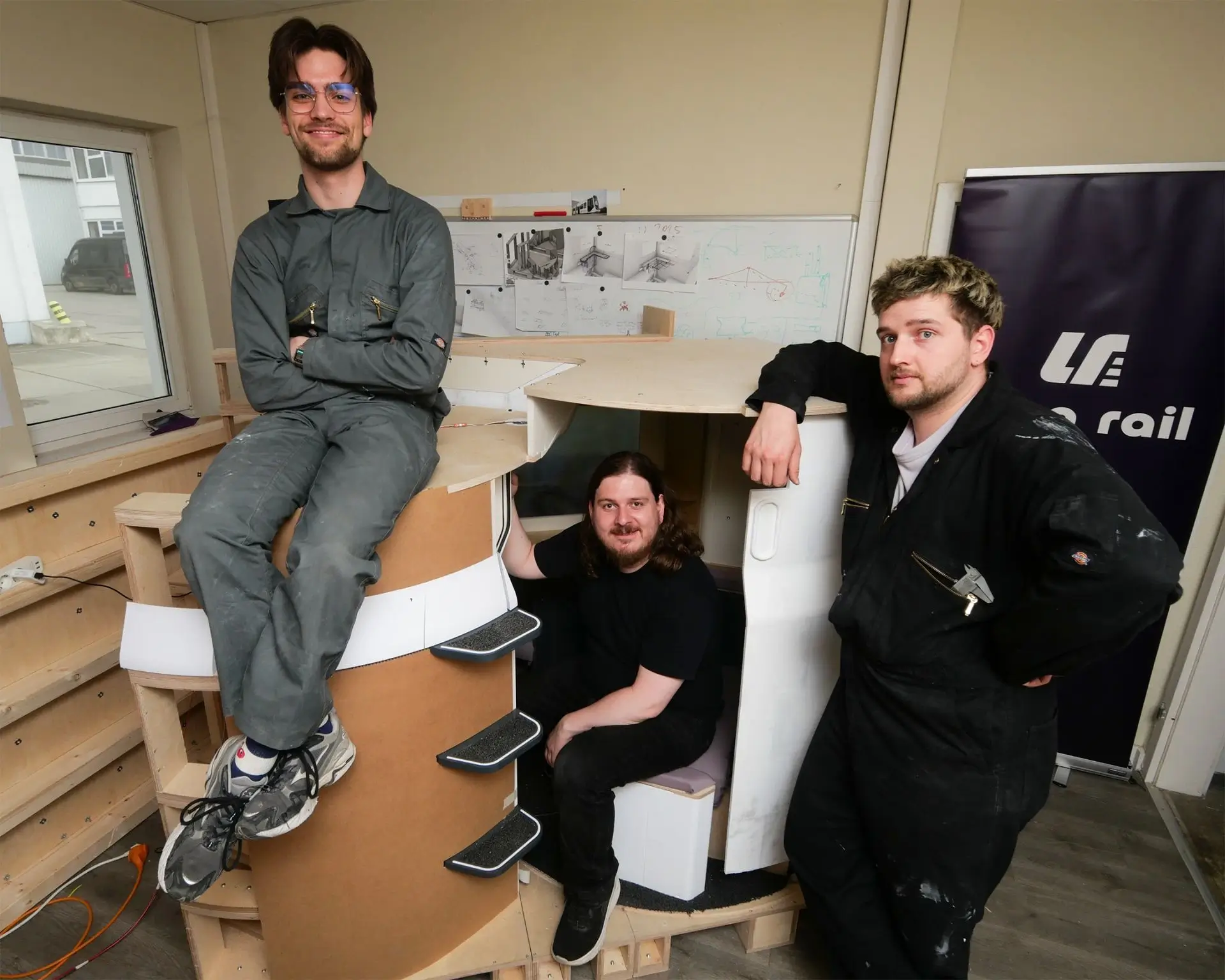
Night trains are back on the agenda across Europe – but not because the old model improved. The problem is well-documented: shared couchettes, low privacy, limited capacity, and coaches that only make economic sense after dark. Luna Rail, a Berlin-based startup, is developing a new generation of train interiors built to fix exactly those problems. Night train innovation is the core of what they’re doing, and their approach is grounded in physical testing rather than renderings.
You can follow their development across their channels: 🌐 luna-rail.com | 📸 Instagram | 🎵 TikTok | ▶️ YouTube | 👥 Facebook
Two Pod Types:
Luna Rail has developed two distinct cabin concepts – the Hotel Pod and the Seat Pod.
The Hotel Pod is a private single cabin for one passenger, with a sofa by day and a full bed at night. It also comes in two and three-passenger variants. Their data shows 94% of test users rated the sleeping position as satisfactory or better, and 49% found a day trip in the Hotel Pod more attractive than first class on a high-speed train.
The Seat Pod targets higher capacity. It converts between a private seat and a lie-flat bed, and Luna Rail claims it offers 50% more capacity than existing approaches used by ÖBB (Austrian Federal Railways), while still giving each passenger direct aisle access and individual privacy.
Built and Tested Physically:
Luna Rail’s development process has included full-sized physical mock-ups with hundreds of test participants across multiple iterations. That’s a meaningful distinction in hardware-adjacent startups, where many teams spend years in CAD before anyone actually sits in the product.
Their test results are published on the site. On sustainable train travel competitiveness for a 1,000km trip at a 100€ ticket price, 60% of users found the Seat Pod attractive for overnight travel – compared to 35% for a shared couchette and 40% for a budget airline. At 150€ with the Hotel Pod, more users preferred the pod over a full-service airline.
These numbers are from internal user testing, not third-party research, but the methodology – comparative attractiveness scoring across real alternatives – gives them practical meaning.
The Capacity Problem Addressed:
The structural issue with night trains today is that a coach running only at night is an underutilized asset. Luna Rail’s design targets this directly. Their patent-pending approach is built around a central corridor with cabins on multiple sides, maximizing the number of private spaces per single-deck car. In the long term, their patented full configuration is designed to increase capacity by a further 25% beyond the near-term version.
This matters for sleeper train cabin economics. More passengers per car means lower per-seat costs, which enables lower ticket prices, which drives higher occupancy – a cycle that makes night train operations more viable.
Emissions Context:
Night trains offer a sustainable train travel alternative to aviation at a fraction of the emissions per passenger-km – that is Luna Rail’s core positioning. Their product is designed to attract airline passengers, not just existing rail users, by making the experience genuinely competitive on comfort and price.
German national broadcaster MDR featured Luna Rail in their “Einfach Genial” format in February 2025, covering the development process and user tests.
More recently, Luna Rail was also featured on DW News, available in both English and German, marking a significant step in international visibility for the project.
App and Booking Layer:
Luna Rail is also developing an app that handles booking, cabin control, door unlocking, and onboard service. The cabin design and app share a consistent design language, which suggests the team is thinking about the full user journey rather than just the hardware.
The startup is supported by Germany’s Federal Ministry for Economic Affairs and Climate Action (BMWK), ZIM (Central Innovation Programme for SMEs), and IBB (Investitionsbank Berlin).
Their Near-term Focus:
For now, Luna Rail is adapting their technology to fit existing conventional rail cars – not waiting for purpose-built vehicles. The shorter-term version, with cabins around a central corridor, is intended to be deployable on current rolling stock. The longer-term full configuration, with cabins on all sides of the corridor, represents their complete patented system.
Anyone tracking rail travel alternatives to flying, or watching the night train network expansion across Europe, should follow their progress. Luna Rail’s approach page and virtual walk-through are worth exploring if you want the technical depth beyond what the homepage covers.