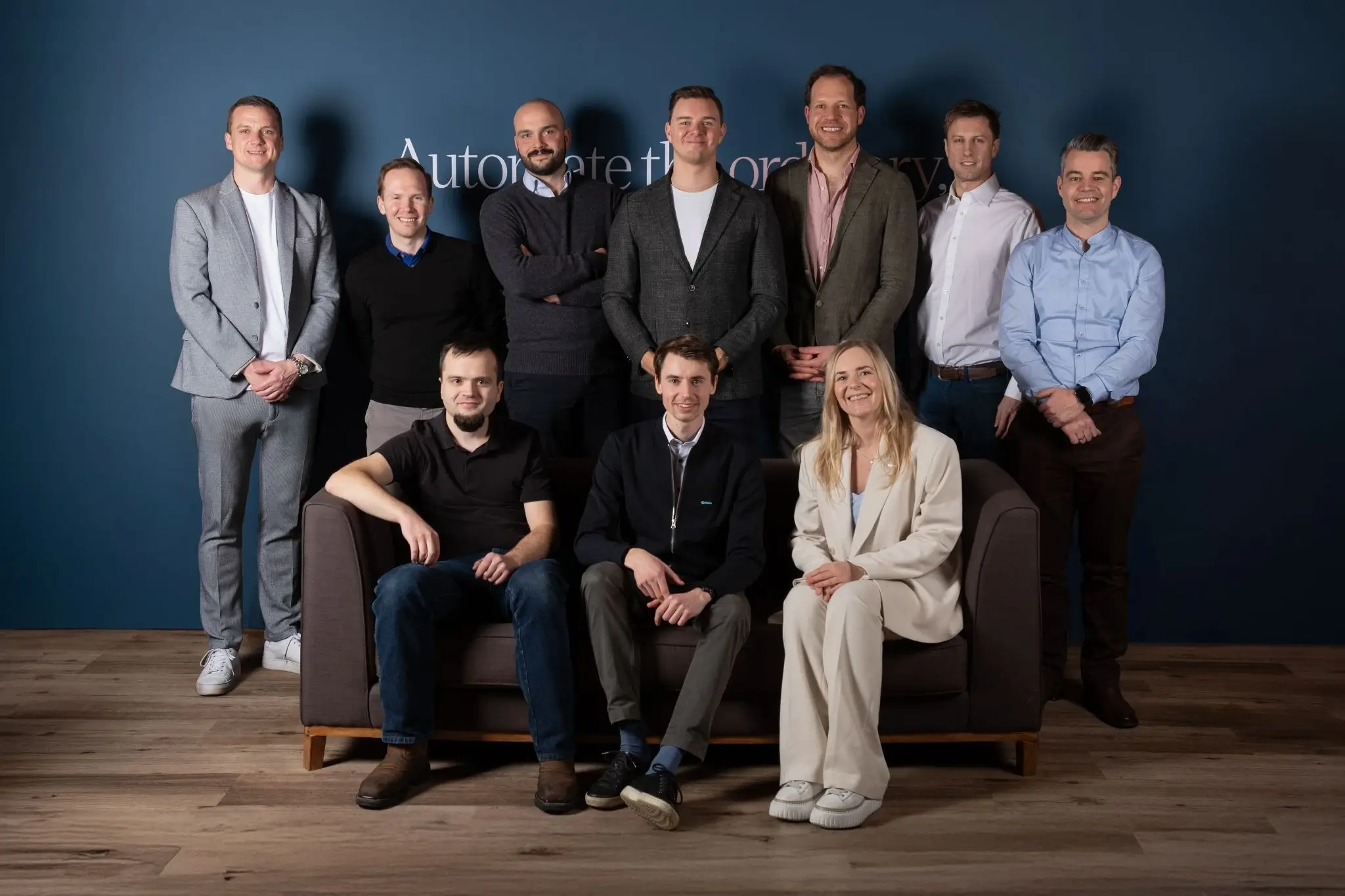
Munich-based RobCo closed a $100 million Series C on January 29. That’s not just another robotics funding round – it’s confirmation that physical AI manufacturing automation has moved from pilot programs to production-critical infrastructure.
The funding, co-led by Lightspeed Venture Partners and Lingotto Innovation, tells you where the smart money thinks industrial robotics is heading. RobCo’s bet? Software-defined robots that learn tasks through demonstration instead of manual programming.
Roman Hölzl, CEO and Founder of RobCo, said: “With the additional $100 million in funding, we aim to make RobCo the leading provider of AI-powered robotics for industrial manufacturing in the US and Europe. Our clear objective is to automate repetitive tasks so people can focus on more demanding work.”
What Makes RobCo Different:
RobCo operates as a full-stack physical AI platform. They build both the hardware (modular robotic arms) and the software (AI-powered vision and motion planning) as a unified system.
The company’s robots handle machine tending, palletizing, dispensing, and welding across manufacturing environments. Current customers include BMW, DynaEnergetics, Fabricated Extrusion Company, and T-Systems.
What separates RobCo from traditional industrial robotics? Their robots acquire skills through demonstration and self-learning. No complex programming required. An operator shows the robot what to do, and the AI figures out how to replicate and optimize the task.
This matters because traditional industrial robots require specialized integrators and weeks of programming for each new task. RobCo’s approach cuts deployment from months to weeks.
The Physical AI Timing:
Jensen Huang called it at CES 2026: “The ChatGPT moment for physical AI is here.”
He’s not wrong. Physical AI – robots that combine perception, decision-making, and physical action in real-time – is transitioning from research labs to factory floors.
The numbers back this up. The International Federation of Robotics reports global industrial robot installations hit a market value of $16.7 billion. ABI Research predicts RaaS deployments will generate $34 billion in revenue by 2026, with 1.3 million installations globally.
RobCo’s U.S. expansion in 2025 (offices in San Francisco and Austin) positions them to capture demand from manufacturers dealing with labor shortages, reshoring initiatives, and rising operational complexity.
Why Robotics as a Service Wins:
RobCo delivers robots through a robotics-as-a-service model. Customers pay a recurring subscription instead of large upfront capital expenditures.
This shifts robotics from capital expense to operational expense. For manufacturers, that means:
- No $500k-$2M upfront hardware investment
- Continuous software updates and hardware improvements
- 24/7 support and maintenance included
- Ability to scale robot count up or down based on demand
The RaaS model matters more in 2026 than it did two years ago. Manufacturing companies can’t afford to buy robots that become obsolete as AI models improve every quarter. RobCo’s subscription model ensures customers always have access to the latest AI capabilities without hardware refresh cycles.
Traditional automation vendors are stuck in the old playbook: sell expensive hardware, charge for programming, add service contracts. RobCo bundles everything into predictable monthly costs.
The Labor Economics:
U.S. manufacturing wages hit $34/hour in 2025 and are projected to reach $39 by decade’s end. Meanwhile, robot costs continue compressing while capabilities expand.
More than 1 million U.S. manufacturing jobs went unfilled in 2025. Physical AI robots aren’t replacing workers in most cases – they’re filling positions companies can’t hire for.
RobCo’s autonomous systems can run night shifts after human operators set them up at end of day. That’s doubling throughput without doubling headcount.
What This Means for Competitors:
RobCo’s $100M raise puts pressure on competitors like Universal Robots, ABB (which sold its robotics division to SoftBank), and newcomers like Path Robotics.
The competitive battleground is shifting from hardware specs to AI capabilities. How fast can the robot learn new tasks? How well does it adapt to variable conditions? How much operator expertise is required?
Companies still selling traditional teach-pendant programming are selling yesterday’s technology. The market wants robots that learn by watching, not robots that require specialized programmers.
The U.S. Manufacturing Play:
RobCo’s U.S. expansion isn’t random. Reshoring initiatives, semiconductor fab construction, and EV component manufacturing are creating demand for flexible automation that can adapt as production requirements change.
Traditional robotic cells are designed for one specific task. Reconfiguring them for new products requires expensive integration work. RobCo’s software-defined approach lets the same hardware tackle different tasks through software updates and retraining.
That flexibility is critical for manufacturers who need to pivot production based on supply chain disruptions, demand shifts, or new product launches.
Where This Goes Next:
Watch for three developments:
Vertical-specific AI models – RobCo will likely develop specialized AI for specific manufacturing processes (welding, finishing, assembly) rather than generic automation platforms. These task-specific models will deliver better quality with less training data.
Robot fleet learning – Currently, each RobCo robot learns individually. The next phase is collective learning where insights from one robot improve the entire fleet. Expect RobCo to implement this by late 2026 or early 2027.
Edge AI expansion – As AI inference gets cheaper and faster, more intelligence will move to the robot itself rather than cloud processing. This reduces latency and enables offline operation.
Key Takeaways:
RobCo’s $100M Series C validates that physical AI manufacturing automation has reached commercial viability. The combination of demonstration learning, robotics-as-a-service delivery, and full-stack integration addresses real problems manufacturers face today.
If you’re evaluating industrial automation in 2026, the baseline question has shifted. It’s no longer “should we automate?” It’s “what level of autonomy do we need, and how quickly can we deploy it?”
Traditional industrial robots still have a place for high-volume, unchanging tasks. But for manufacturers dealing with product variety, frequent changeovers, or unpredictable demand – software-defined physical AI robots like RobCo’s are becoming the default choice.
The companies moving fastest on this aren’t waiting for perfect technology. They’re deploying now, learning from real production data, and iterating. That’s the only way to build institutional knowledge around autonomous systems before they become table stakes.