Vexlum, a cutting-edge Finnish Semiconductor Manufacturer, has raised EUR 10 million to expand its in-house laser technology and semiconductor chip production operations in Finland.
Funding Breakdown and Strategic Investors:
The round consists of EUR 6 million in equity investment led by Kvanted, with participation from Finnish state-owned Tesi (Finnish Industry Investment Ltd) and the EIC Fund, alongside a EUR 2.4 million grant from the EIC Accelerator, and a EUR 1.6 million loan from Nordea.
The semiconductor-based Vertical-External-Cavity Surface-Emitting Laser (VECSEL) technology from Vexlum solves a major problem in high-tech industries: the absence of small, affordable, high-power laser sources at specific wavelengths. Lasers play a major role in applications like atomic clocks, quantum computers, next-generation semiconductor metrology, and free-space optical communication technologies.
Following the launch of many product lines, Vexlum is now responding to significant market demand by increasing its manufacturing capacity in Finland to guarantee quality and speed.
Jussi-Pekka Penttinen, CEO and Co-founder of Vexlum, says: “Securing and scaling our semiconductor fabrication infrastructure is critical for the market’s evolution. It allows us to ensure that the laser quality and reliability meet our customers’ stringent requirements. We are moving beyond boutique production to industrial-scale capability. This funding allows us to bring our semiconductor manufacturing into a new, expanded facility here in Tampere and scale our capacity to meet the demand from the quantum, semiconductor, and space sectors.”
Molecular beam epitaxy, which is similar to 3D printing on an atomic scale, is the first step in the creation of Vexlum’s chips. In this process, the semiconductor wafer is “grown” in a reactor, atomic layer by atomic layer.
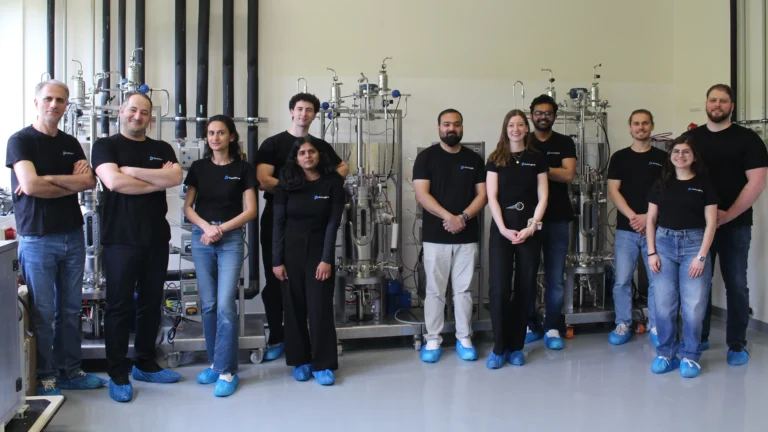
Vexlum creates laser wafers for particular wavelengths using III-V semiconductor materials (such as gallium arsenide, indium phosphide, and gallium antimonide) as opposed to silicon, which is utilized in conventional electronics. In a specialized cleanroom, the wafers are formed into laser chips. The ready-made, quality-controlled chips are then incorporated into laser systems to produce laser light. This vertical integration in a Vexlum-owned facility enables the business to meet customer needs and manage the complete value chain, from chip manufacture to the finished laser system.
Mircea Guina, Chairman and Co-Founder of Vexlum, commented: “Tampere has emerged as a leading hub for optoelectronics and III-V semiconductor technology, building on a strong foundation of world-class academic research and a proven ability to translate it into industrial innovation. This investment round represents a decisive step in scaling our ambitions, securing a leading position for Tampere and Finland in the advanced semiconductor industry.”
The funding, which may be the biggest seed round ever secured by a photonics startup in the area, is an important turning point for the Nordic deep tech sector. Vexlum’s growth strategy, which aims for EUR 100 million in revenue by 2030, will be fueled by the funding.
Vexlum is a shining example of the Tampere region’s deep-tech technical prowess in laser technology, according to Kvanted, a Nordic venture capital firm that specializes in industrial technology.
Axel Ahlström, Founding Partner at Kvanted, said: “We are not just investing in a laser company. Instead, we are investing in a semiconductor manufacturer that has cracked the code on scaling high-power, precise wavelengths for the world’s most difficult problems. Our fund is proud to back a team that is turning this know-how into a global category leader.”
Vexlum, which is currently a significant supplier for trapped-ion quantum computers, can power solutions far beyond quantum labs thanks to its capacity to produce lasers at a variety of wavelengths. For instance, the technology is being developed to enable next-generation optical atomic clocks that seek to redefine the precision of timekeeping, to improve the reliability of satellite optical communications, and for other applications where particular laser colors are required.
Jussi-Pekka Penttinen, continued: “The quantum ecosystem has taught us that extreme precision is only valuable if it can be delivered reliably and at scale. We are now taking those hard-won lessons and applying them to the broader photonics landscape. Whether for satellite communications or semiconductor metrology, we are proving that the rigorous architecture developed for quantum computers is the same engine needed to drive the next generation of industrial innovation.”