Most satellites today still run on hydrazine, a propellant so toxic it requires hazmat-level handling at every launch site. Arkadia Space green propulsion technology is built to change that. The startup has been selected by the European Innovation Council (EIC) Accelerator, securing €14.5 million in funding.
The financing package includes a €2.5 million grant, €6 million in equity from the EIC Fund, and an additional €6 million from private investors. Out of 923 applicants, only 61 companies were selected, a success rate of 6.6%. With this, Arkadia became the first Spanish space company to receive backing from the programme.
The Problem With Current Fuels:
Hydrazine and its derivatives have powered satellites for decades. They are effective but highly toxic, heavily regulated under European law, and expensive to handle safely at every launch site.
Arkadia is developing a hypergolic bipropellant system based on high-concentration hydrogen peroxide and a proprietary green fuel, designed to replace hydrazine and its derivatives. Its hypergolic nature enables instantaneous ignition when both propellants contact each other, eliminating the need for complex ignition systems and increasing reliability for maneuvers like spacecraft docking.
Technology Already in Orbit:
This is not a paper concept. In March 2025, Arkadia successfully validated its DARK propulsion system in orbit aboard a D-Orbit ION Satellite Carrier on SpaceX’s Transporter-13 rideshare mission from Vandenberg Space Force Base. This marked the first time a hydrogen peroxide-based propulsion system reached space in Europe.
By June 2025, the company confirmed successful in-orbit test firings, including both short pulses and longer steady-state burns, with on-orbit performance matching ground test data. That validated performance record is what satellite operators need before committing to a new propulsion supplier.
What the Cost Numbers Show:
The system significantly improves safety during handling and operations, while cutting operational and refuelling costs by more than 60% compared to conventional solutions.
A key practical benefit is that hydrogen peroxide can be fuelled at the launch site without the hazardous procedures hydrazine demands, cutting pre-launch costs and complexity for satellite operators directly. That saving applies across every mission, not just once.
Commercial Contracts Already Signed:
The Castellón-based SpaceTech startup Arkadia has also developed ARIEL, a 250-newton monopropellant thruster designed for reaction control systems on launch vehicles and spacecraft, built under contract with ESA’s Future Launchers Preparatory Programme. ARIEL reached technology readiness level six within two years of the initial ESA contract signed in June 2023. Arkadia has since secured a contract to supply reaction control thrusters for MaiaSpace, the reusable launch vehicle programme backed by ArianeGroup. Additional commercial contracts are expected to be announced in the coming months of 2026.
Why the EIC Selection Matters:
Beyond the financial contribution, the EIC selection carries a strategic dimension, reflecting a European commitment to green propulsion technologies, which are key within the satellite and space vehicle supply chain. The goal is to build a fully European supply chain, free from third-party dependencies and ITAR restrictions.
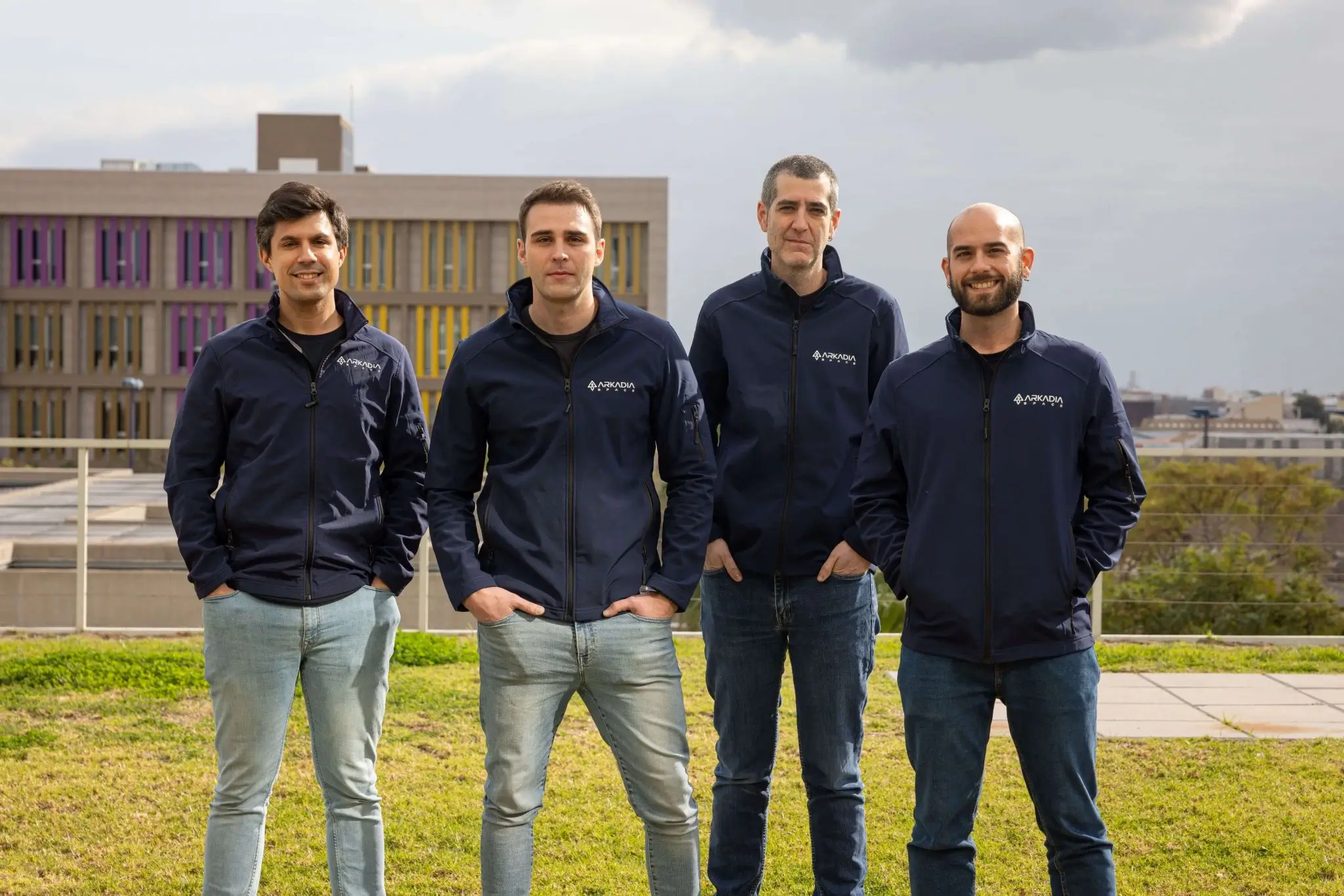
Founded in 2020 by Francho García alongside Francisco Espinosa, Ismael Gutiérrez, and Sergio Soler, all formerly of PLD Space, the team brought hands-on propulsion experience from day one. That foundation shows in how quickly the company moved from early development to orbit-validated hardware with signed commercial deals.
The EIC funding will support further R&D, expansion of the private test center at Castellón Airport, and the scaling of commercial operations. For founders and operators tracking European satellite propulsion startups or EIC Accelerator-backed deep tech companies, Arkadia is a useful data point on how hardware-first development can move at pace inside a heavily regulated sector.
Arkadia Space green propulsion has moved from early-stage validation to signed contracts and institutional backing in a short window. With in-orbit testing complete and commercial deployment targeted for 2026, the company is in its scaling phase with a clear path forward.